
- Detalhes
- Escrito por Guilherme
- Categoria: Uncategorised
- Acessos: 291

O Programa de Pós-Graduação em Economia Política Internacional (PEPI) do Instituto de Economia da UFRJ vem, por meio desta nota, somar-se ao Instituto de História da UFRJ e manifestar seu apoio e solidariedade ao historiador e professor titular Francisco Carlos Teixeira da Silva, também professor permanente do nosso programa e referência nos estudos de história moderna.
Francisco Teixeira foi recentemente processado por sua reconhecida produção acadêmica crítica ao golpe de abril de 1964 e à ditadura militar no Brasil. O processo, aberto pelo general da reserva Álvaro Pinheiro, o acusa de calúnia, difamação e “falsificação da história”, e pede indenização e cassação dos títulos acadêmicos do professor.
O PEPI ressalta a necessidade intransigível de defesa dos direitos de exercício da atividade acadêmica, cujo ofício inclui a produção sustentada de análises que apresentem à sociedade reflexão rigorosa sobre a conjuntura e sobre o passado. As tentativas de silenciar o trabalho acadêmico representam clara ameaça ao próprio Estado democrático de direito. E são um reeditado episódio das sucessivas tentativas de calar vozes que se opõem ao período ditatorial vivido no Brasil.
- Detalhes
- Escrito por Guilherme
- Categoria: Uncategorised
- Acessos: 229
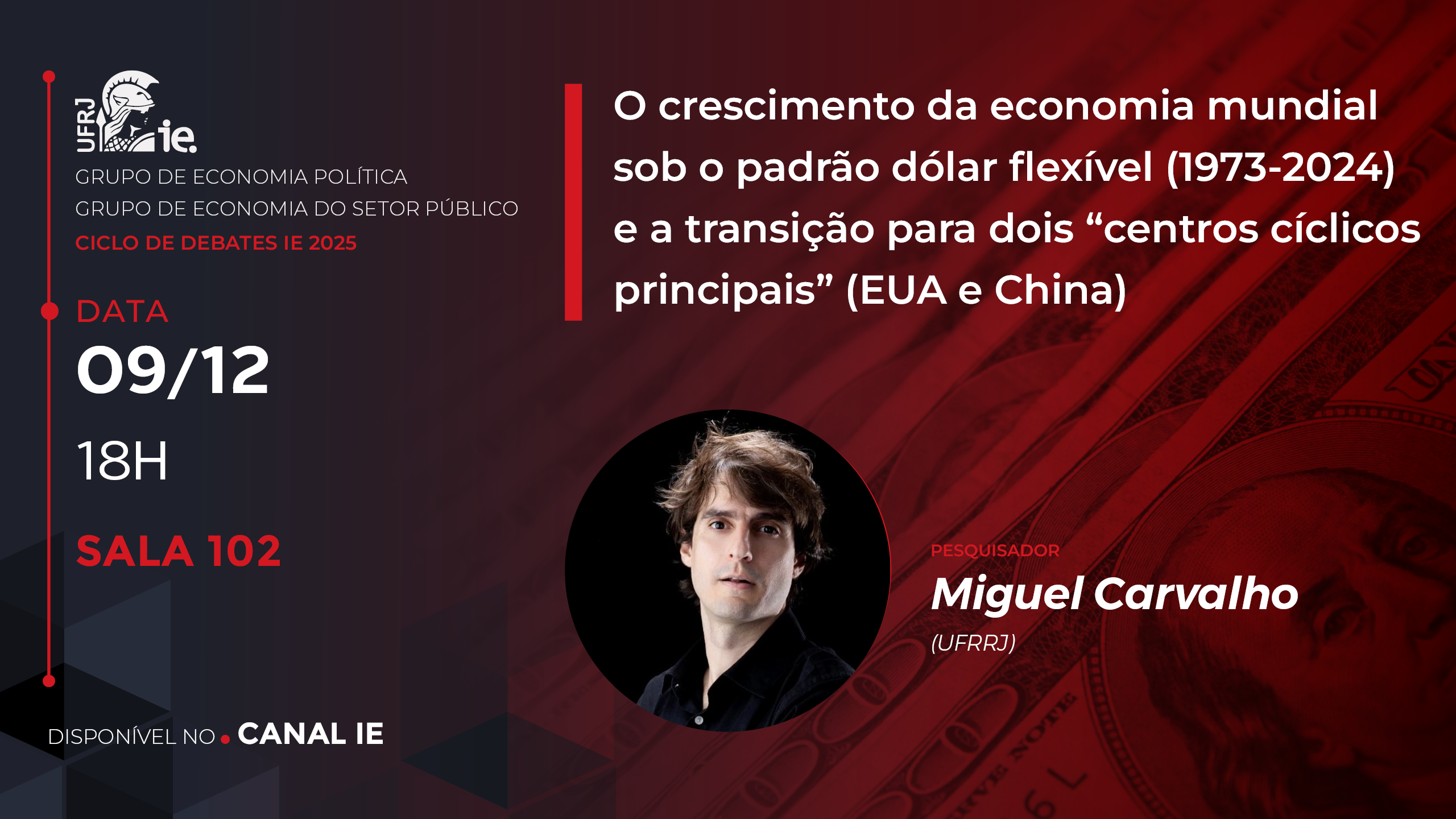
Gostaríamos de convidar a todos para o último encontro do Grupo de Economia Política da UFRJ deste ano. O seminário contará com a apresentação do professor da UFRRJ e pesquisador do Grupo, Miguel Henriques de Carvalho, discutindo ‘O crescimento da economia mundial sob o padrão dólar flexível (1973-2024) e a transição para dois “centros cíclicos principais” (EUA e China)’. Dessa vez o evento não será transmitido.
SEMINÁRIO DO GRUPO DE ECONOMIA POLÍTICA“O CRESCIMENTO DA ECONOMIA MUNDIAL SOB O PADRÃO DÓLAR FLEXÍVEL (1973-2024) E A TRANSIÇÃO PARA DOIS 'CENTROS CÍCLICLOS PRINCIPAIS' (EUA E CHINA)”
PESQUISADOR: Miguel Carvalho (UFRRJ)
DATA: 3a-feira dia 09/12, às 18hs
LOCAL: SALA 102
Contamos com a sua presença!
Organização do Grupo de Economia Política
- Detalhes
- Escrito por Guilherme
- Categoria: Uncategorised
- Acessos: 327
- Detalhes
- Escrito por Guilherme
- Categoria: Uncategorised
- Acessos: 269
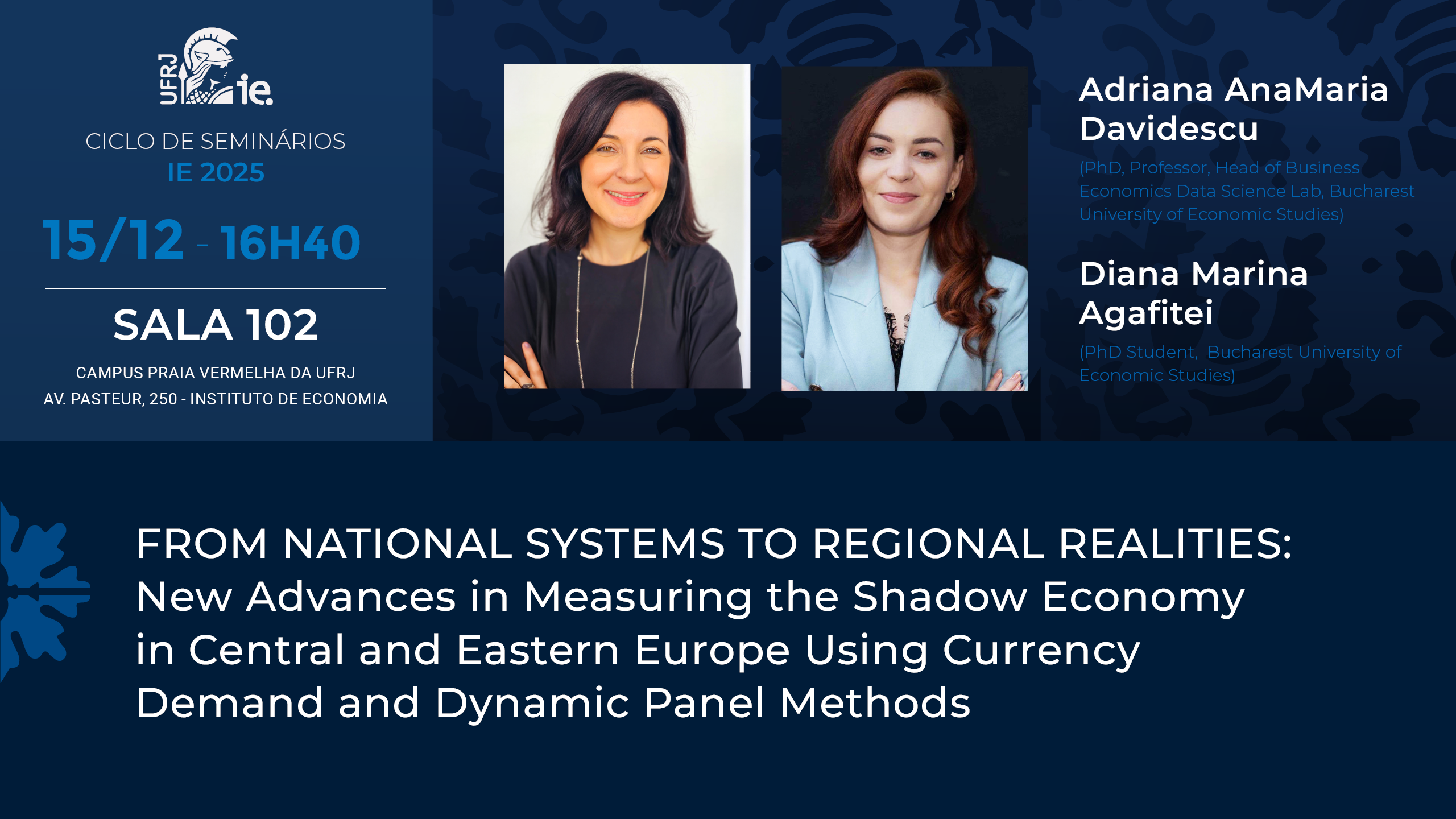
From National Systems to Regional Realities: New Advances in Measuring the Shadow Economy in Central and Eastern Europe Using Currency Demand and Dynamic Panel Methods
PALESTRANTES E FILIAÇÃO INSTITUCIONAL:Adriana AnaMaria Davidescu(PhD, Professor, Head of Business Economics Data Science Lab, Bucharest University of Economic Studies).Diana Marina Agafitei(PhD Student, Bucharest University of Economic Studies)
DATA: 15/12/2025 (segunda-feira)
HORA: 15h
SALA: 102
ABSTRACT: The seminar brings together two complementary strands of research that significantly advance the empirical understanding of the shadow economy in Central and Eastern Europe (CEE), by integrating macro-level and regional-level perspectives within the Currency Demand Approach (CDA) and dynamic panel frameworks.The first study develops an enhanced variant of the CDA embedded in a Pooled Mean Group Autoregressive Distributed Lag (PMG–ARDL) model using data for 13 CEE countries between 1995 and 2022. The analysis reveals taxation as the dominant long-run driver of excess currency demand, alongside income growth, interest rate dynamics, financial infrastructure, and most critically, enforcement strength. Through counterfactual simulations and Monte Carlo optimisation, the study demonstrates that informality can only be substantially reduced under conditions of robust institutional enforcement combined with realistic fiscal pressure, highlighting the structural persistence of shadow activity in post-transition economies.The second study extends this framework to the regional level by proposing an innovative methodology for generating NUTS-2 estimations of the informal economy in 11 CEE EU member states from 2001 to 2021. By integrating a hybrid regionalisation approach, combining economic weights with structural composite indices, and estimating regional CDA-PMG models, this paper uncovers sizeable intra-national disparities in informality. Capital regions consistently display lower shadow economy shares, whereas structurally weaker and rural regions exhibit persistent informality driven by enforcement gaps, labour market structures, and financial inclusion differentials.Together, the two studies offer a unified analytical framework in which national-level structural determinants and regional heterogeneities are mutually reinforcing. They show that while macro-institutional reforms reduce informality in the long run, spatial disparities persist when regional enforcement, digitalisation, and sectoral structures diverge. The seminar, therefore, provides an integrated narrative on how methodological innovation in CDA estimation, combined with dynamic panel modelling and regionalisation techniques, can support more effective and territorially sensitive strategies to curb informal economic activity in CEE.
- Detalhes
- Escrito por Guilherme
- Categoria: Uncategorised
- Acessos: 389